
Searching for trips..
SeaTrek in Search of Wallace and His Living Treasures with Dr George, Zoologist and Wallace Expert
view cabin photo

view cabin photo
Additional charges:
Fuel Surcharge 2026 $200 USDSeaTrek in Search of Wallace and His Living Treasures with Dr George, Zoologist and Wallace Expert itinerary:
We will visit the Kedaton, the palace of the Sultan of Ternate, with its rich collection of heirlooms and some old forts, the Portuguese-built Toluku and the Dutch-built Oranje, and the probable site of the house where Wallace was living when he posted his essay on natural selection to Charles Darwin in 1858.
Visit the village of Dodinga: the very place where Wallace was living when, in a fit of malarial delirium, he discovered the mechanism which drives evolutionary change – natural selection. Dodinga is a pretty little riverside village with friendly people, colourful houses, and the ruins of an old Portuguese fort, and its importance in the history of science cannot be understated.
Visit the Guraici Archipelago, a chain of islands with white sandy beaches, vibrant coral reefs, and some lovely local villages. We will spend a full day here snorkelling, swimming, and beachcombing. The islands are part of a government-controlled conservation area, designed to protect the reefs and the many beautiful marine species that live there.
We will wake up on the western coast of Bacan, another of Indonesia’s historic spice sultanates. We go ashore to explore the forested slopes where Wallace made some of his greatest zoological discoveries, including the Moluccan Cuscus, the Standardwing Bird of Paradise, and the huge and magnificent Golden Birdwing Butterfly. Wallace described the latter species as the “finest butterfly in the world”.
We will also keep a close watch for these and a host of other animals, some of them endemic to these islands, including parrots, cockatoos, lorikeets, hornbills, the elusive cuscus, and hopefully the endangered black-crested macaque – the only monkey in Maluku.
We pay a visit to the Pisang Islands. These tiny gems isolated in the vast waters of the Ceram Sea offer us a chance to relax and enjoy the sparkling white-sand beaches, clear waters, and vibrant reefs before making our way to the shores of West Misool.
We will visit a seaside village in Misool, where we will visit the school and learn about the way the Nature Conservancy is working with the village to empower local women with a fishing practice called ‘Sasi’.
We will be snorkelling at a channel that divides two islands, where sea fans hang in the drop-offs, and the current is rich in nutrients.
The afternoon will be a laid-back day spent strolling the white-sandy beach and snorkeling the reef where juvenile black-tip reef sharks usually frequent. You will also have the chance to play beach volleyball if you are interested.
This morning, we will wake to see the sun rise over the picturesque chain of islands that make up the eastern part of the Misool archipelago. The topography is typical of ‘karst dissolution’, featuring a great number of tiny islets whose bases have been eroded over time by the relentless motion of the tides.
We will then move on to a mysterious jellyfish lake and swim amongst the many thousands of stingless animals: undoubtedly one of Raja Ampat’s most memorable activities. We use our tenders to explore more of this impressive maze of karst islands, both above and below the surface, complete with prehistoric cave paintings, estimated to be between 3,000 to 5,000 years old and depicting various human figures and huge human palms, fish, plants, tools, and vessels.
We will visit a small island group for a short hilltop climb to take in the amazing views. After some great snorkelling on the island’s reefs, we will set course for a local village, where the local children will perform their traditional dances for us.
We can also walk around the village and gain a sense of the Asai culture, which is still kept very much alive by the villagers living in this isolated place. There’s a chance that we may get to see some manta rays as we snorkel, but there are no guarantees.
Today will present another opportunity for keen naturalists, as we rise early and walk into the forest on a pre-dawn quest to spot the remarkable Red Bird of Paradise, one of the species that Wallace was most anxious to collect. With a little luck and the help of our knowledgeable guides, we will see this rare bird’s elaborate courtship display as dawn breaks over the forest canopy.
We will rise at 4.30 am, ready to head into the forest on a pre-dawn quest to spot the gorgeous Wilson’s Bird of Paradise. We hope that the efforts of our early start will pay off, enabling us to catch a rare and privileged sight of the bird’s elaborate courtship dance as the day breaks over the forest canopy.
We will have an epic snorkel adventure on one of Raja Ampat’s best reefs, where hundreds of species can be found, including large schools of fish of all sizes and a massive diversity of coral species. The boat will then move to a nearby island for more snorkelling and the opportunity to watch a multitude of bats flying overhead just after sunset.
Once at anchor, we will say goodbye to George, our crew, and our sea-based home, the Ombak Putih, before taking the tenders ashore, where you will be transferred to the airport for your onward travel.
Our mission is to provide the best experience possible for our guests given the current conditions and when unexpected opportunities for adventure may present themselves along our cruise routes. Sometimes weather conditions, tides or other local factors dictate that we need to vary from the published route, and at times there are special opportunities to explore and discover new locations, events and activities. These explorations will always be a definite enhancement to the published itinerary and will be undertaken after discussion and agreement among guests. Ultimately, the boat captains and your tour leader will make decisions to maximize trip safety and your overall enjoyment, so please come prepared to be flexible!
SeaTrek in Search of Wallace and His Living Treasures with Dr George, Zoologist and Wallace Expert reverse itinerary:
Our mission is to provide the best experience possible for our guests given the current conditions and when unexpected opportunities for adventure may present themselves along our cruise routes. Sometimes weather conditions, tides or other local factors dictate that we need to vary from the published route, and at times there are special opportunities to explore and discover new locations, events and activities. These explorations will always be a definite enhancement to the published itinerary and will be undertaken after discussion and agreement among guests. Ultimately, the boat captains and your tour leader will make decisions to maximize trip safety and your overall enjoyment, so please come prepared to be flexible!
We will rise at 4.30 am, ready to head into the forest on a pre-dawn quest to spot the gorgeous Wilson’s Bird of Paradise. We hope that the efforts of our early start will pay off, enabling us to catch a rare and privileged sight of the bird’s elaborate courtship dance as the day breaks over the forest canopy.
We will have an epic snorkel adventure on one of Raja Ampat’s best reefs, where hundreds of species can be found, including large schools of fish of all sizes and a massive diversity of coral species. The boat will then move to a nearby island for more snorkelling and the opportunity to watch a multitude of bats flying overhead just after sunset.
Once at anchor, we will say goodbye to George, our crew, and our sea-based home, the Ombak Putih, before taking the tenders ashore, where you will be transferred to the airport for your onward travel.
We will visit a small island group for a short hilltop climb to take in the amazing views. After some great snorkelling on the island’s reefs, we will set course for a local village, where the local children will perform their traditional dances for us.
We can also walk around the village and gain a sense of the Asai culture, which is still kept very much alive by the villagers living in this isolated place. There’s a chance that we may get to see some manta rays as we snorkel, but there are no guarantees.
Today will present another opportunity for keen naturalists, as we rise early and walk into the forest on a pre-dawn quest to spot the remarkable Red Bird of Paradise, one of the species that Wallace was most anxious to collect. With a little luck and the help of our knowledgeable guides, we will see this rare bird’s elaborate courtship display as dawn breaks over the forest canopy.
This morning, we will wake to see the sun rise over the picturesque chain of islands that make up the eastern part of the Misool archipelago. The topography is typical of ‘karst dissolution’, featuring a great number of tiny islets whose bases have been eroded over time by the relentless motion of the tides.
We will then move on to a mysterious jellyfish lake and swim amongst the many thousands of stingless animals: undoubtedly one of Raja Ampat’s most memorable activities. We use our tenders to explore more of this impressive maze of karst islands, both above and below the surface, complete with prehistoric cave paintings, estimated to be between 3,000 to 5,000 years old and depicting various human figures and huge human palms, fish, plants, tools, and vessels.
We will visit a seaside village in Misool, where we will visit the school and learn about the way the Nature Conservancy is working with the village to empower local women with a fishing practice called ‘Sasi’.
We will be snorkelling at a channel that divides two islands, where sea fans hang in the drop-offs, and the current is rich in nutrients.
The afternoon will be a laid-back day spent strolling the white-sandy beach and snorkeling the reef where juvenile black-tip reef sharks usually frequent. You will also have the chance to play beach volleyball if you are interested.
We will wake up on the western coast of Bacan, another of Indonesia’s historic spice sultanates. We go ashore to explore the forested slopes where Wallace made some of his greatest zoological discoveries, including the Moluccan Cuscus, the Standardwing Bird of Paradise, and the huge and magnificent Golden Birdwing Butterfly. Wallace described the latter species as the “finest butterfly in the world”.
We will also keep a close watch for these and a host of other animals, some of them endemic to these islands, including parrots, cockatoos, lorikeets, hornbills, the elusive cuscus, and hopefully the endangered black-crested macaque – the only monkey in Maluku.
We pay a visit to the Pisang Islands. These tiny gems isolated in the vast waters of the Ceram Sea offer us a chance to relax and enjoy the sparkling white-sand beaches, clear waters, and vibrant reefs before making our way to the shores of West Misool.
We will visit the Kedaton, the palace of the Sultan of Ternate, with its rich collection of heirlooms and some old forts, the Portuguese-built Toluku and the Dutch-built Oranje, and the probable site of the house where Wallace was living when he posted his essay on natural selection to Charles Darwin in 1858.
Visit the village of Dodinga: the very place where Wallace was living when, in a fit of malarial delirium, he discovered the mechanism which drives evolutionary change – natural selection. Dodinga is a pretty little riverside village with friendly people, colourful houses, and the ruins of an old Portuguese fort, and its importance in the history of science cannot be understated.
Visit the Guraici Archipelago, a chain of islands with white sandy beaches, vibrant coral reefs, and some lovely local villages. We will spend a full day here snorkelling, swimming, and beachcombing. The islands are part of a government-controlled conservation area, designed to protect the reefs and the many beautiful marine species that live there.

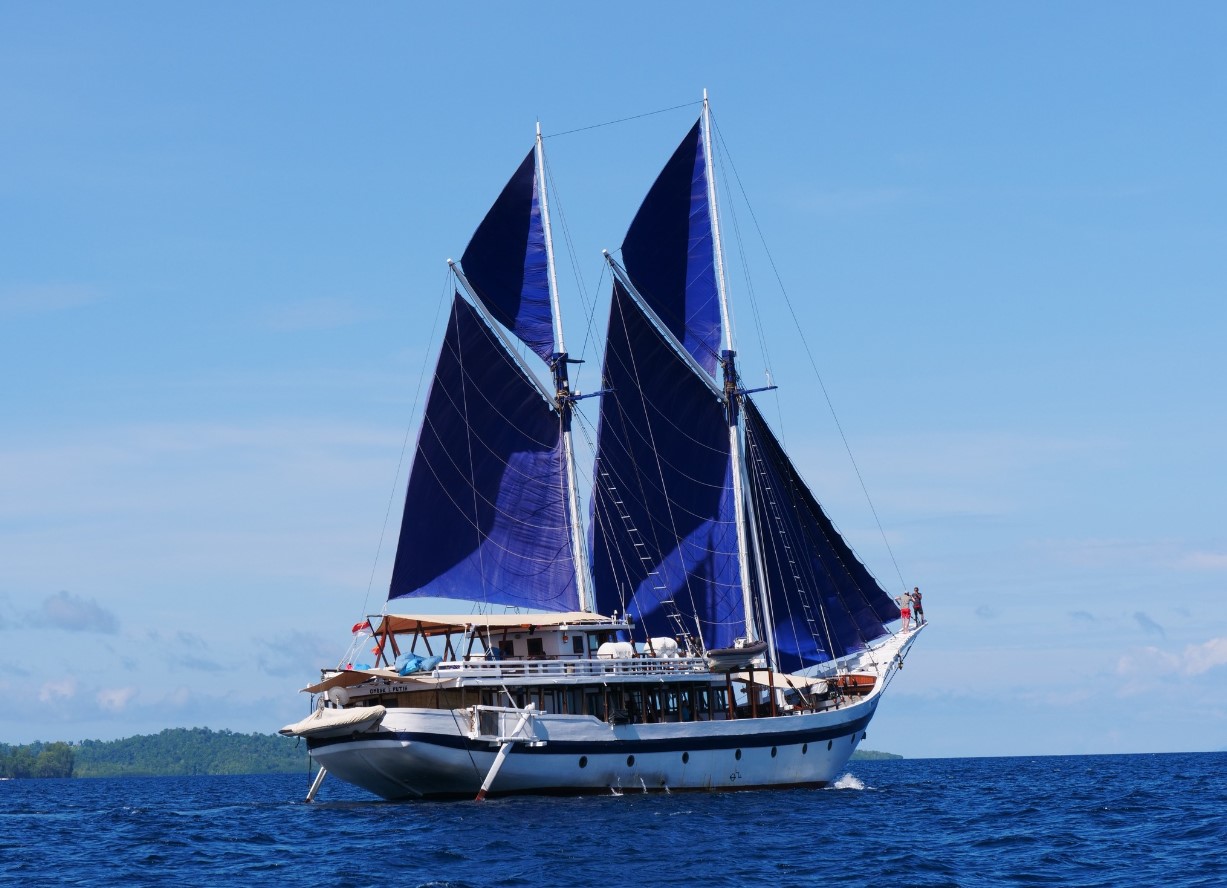
Ombak Putih
Vessel Type: Yacht
Length overall: 42 metres
Passanger Capacity: 24
Led by Captain Jufri, with a crew of 14, Ombak Putih means ‘White Wave’ in the Indonesian language. Her keel was first laid down in Kalimantan in 1995, and she became operational in 1997. At 42 metres long, she is the larger of our two ships, providing accommodation for up to 24 guests in 12 comfortable cabins. Approximately 400 square metres of public space is divided over her two main decks, including a large salon, as well as covered and open areas, allowing plenty of room for our guests to spread out, relax, and enjoy as much company or solitude as they wish.
Twelve superior cabins en-suite bathrooms, Salon & bar.Outdoor covered dining area, Rooftop lounge. Kayaks, Stand,up-paddle boards (SUP). Snorkelling equipment. Fishing gear, Three tender boats. Full complement of crew; engineering and service.
SLEEPING CONFIGURATION
6 x double bed cabins
2 x triple cabins (one double bed and one upper single bunk - bunk ideally suitable for child 12 or under)
4 x twin bunk cabins (one above the other)


• Our tour leaders are a wealth of information on the regions we visit and will prepare you for each activity with on board talks and presentations to give you a greater understanding of the different experiences you will have each day. They will also act as your cross-cultural bridges to all the people we meet along the way, so feel free to ask them to translate when talking to local Indonesian people on your travels.